
Modern Warfare 4 DMZ TL;DR
-
Digital preorders get DMZ early access on October 20, 2026. The full release follows on October 23.
-
You get to choose from several game modes: Story Missions, Dynamic Operations, or Free Roam. Other players are involved in all three.
-
Starting off, use free loadouts to learn the Hajin map and build your Stash.
-
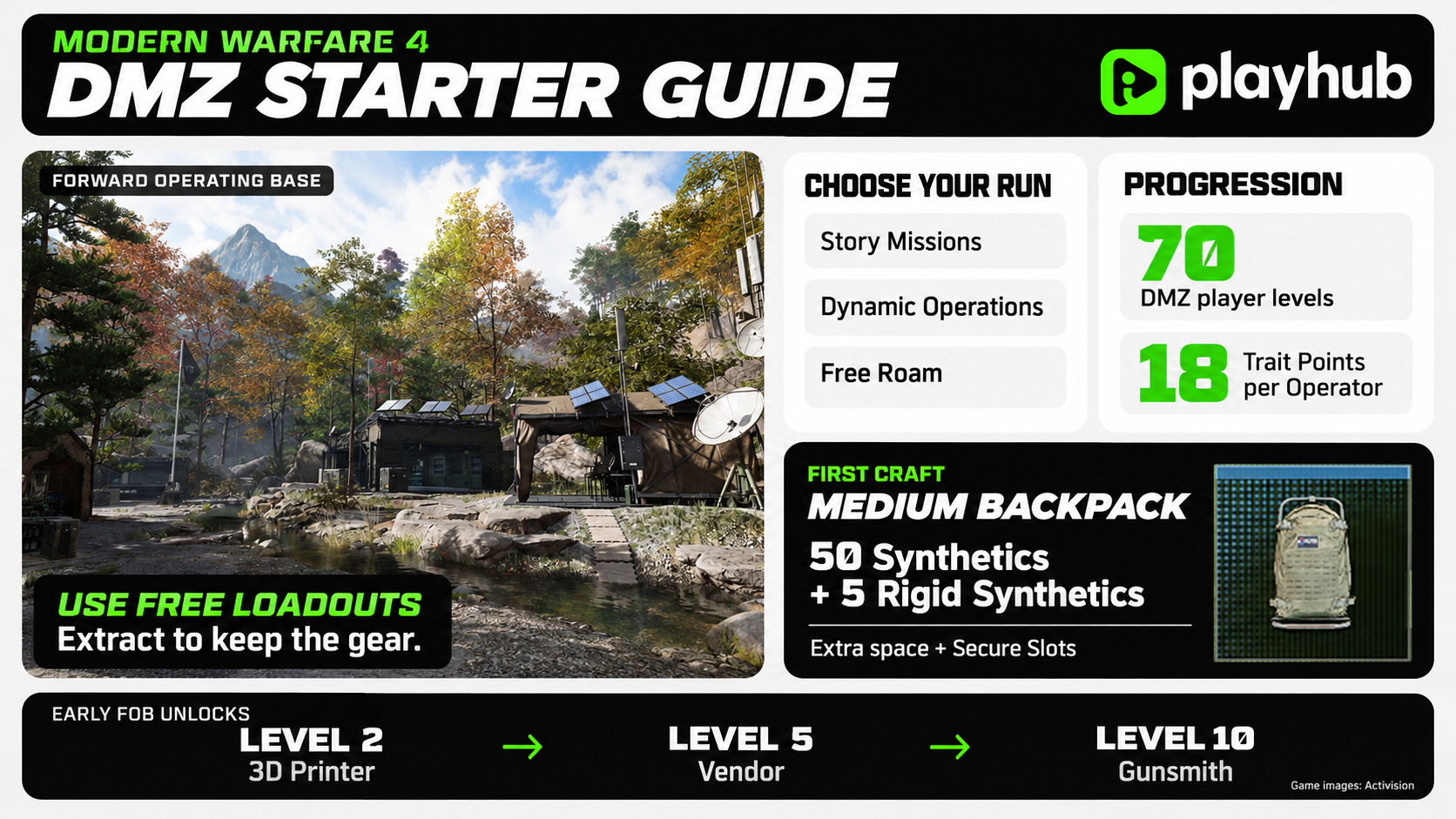
Make crafting the Medium Backpack an early target: 50 Synthetics and 5 Rigid Synthetics gets you extra space and Secure Slots to skyrocket your earnings rate.
-
DMZ player progression reaches level 70. Individual Operators have their own Traits, Prestige, and MIA recovery costs.
Have some skins you weren't able to get? You can buy stacked Call of Duty accounts on Playhub with lots of legacy rewards - all delivered safely and quickly.
What Is DMZ in Modern Warfare 4?
DMZ is CoD’s PvPvE extraction mode. You drop into the Hajin Exclusion Zone, loot equipment conveniently scattered all around the place, fight AI and player squads, and get to an extraction point with whatever loot you managed to get. Between raids, you spend the haul on upgrading your base, weapons, and Operators. You have three deployment options:
|
Deployment option |
What you’re signing up for |
|---|---|
|
Story Missions |
Replayable narrative missions with set objectives |
|
Dynamic Operations |
Multi-stage operations with changing objectives |
|
Free Roam |
Explore Hajin without a selected starting mission |
What I think is very unusual is that the Story Missions still run on a live server with other players on it, so keep watching for players while you deal with the objective. A squad pushing your building won’t care how close you are to finishing it.
DMZ Release Date and Early Access
DMZ early access begins October 20, 2026, for digital Standard and Vault Edition preorders. Everyone else gets access with Modern Warfare 4’s full release on October 23. Campaign early access starts on October 16, so don’t mix up the two dates. You don’t need Vault Edition just to play DMZ early; the digital Standard preorder includes that benefit too. MW4 is coming to PS5, Xbox Series X|S, PC, and Nintendo Switch 2
What Has Changed in MW4 DMZ compared to the OG DMZ?
The original DMZ launched on November 16, 2022, alongside Warzone 2.0. While it was fun at launch for lots of other players and me, the content quickly dried up, and the systems were super shallow compared to what other extraction shooters had to offer even at this time. MW4 keeps the extraction shooter foundation and puts more depth into progression mechanics. The biggest change for returning DMZ players definitely lies in how much you’ll be managing your different upgrade paths between deployments. Here’s the comparison table of both DMZ versions' features:
|
System |
Original DMZ, including later updates |
Modern Warfare 4 DMZ |
|---|---|---|
|
Access |
Free via Warzone 2.0 |
Included in the paid MW4 release |
|
Base |
Menu-based FOB upgrades and passive objectives |
Walkable FOB with crafting, vendors, and other stations |
|
Weapons |
Contraband guns and Insured Weapon slots with recovery cooldowns |
Extract Weapon Manuals to unlock weapon purchases, then spend DMZ Cash on builds |
|
Gear crafting |
Barter recipes at Buy Stations |
3D Printer crafting at the FOB |
|
Operators |
Active Duty slots with separate equipment |
Individual Trait trees, Operator Prestige, and MIA recovery |
|
Objectives |
Faction Missions, contracts, and map activities |
Story Missions, Dynamic Operations, DMZ Orders, and Free Roam |
The original version already had a FOB by the Season 4 update in 2023, plus Barter and Active Duty slots from earlier updates. What interests me here is having more to build toward with each Operator; that looks like a promising system to grind. The biggest downside of the new DMZ is that it’s not free, unlike the first version. Asking the whole friend squad to own MW4 sounds impossible.
How the Forward Operating Base Works
Your Forward Operating Base handles your meta progression between raids. You get to do a bunch of things here using different stations:
|
Station |
Function |
|---|---|
|
Operators |
Choose an Active Duty Operator and manage their Traits |
|
DMZ Orders |
Check mission requirements and rewards |
|
Stash/Loadout |
Store your haul and equip the next run |
|
3D Printer |
Craft gear and FOB upgrades |
|
Vendor |
Spend DMZ Cash on rotating equipment offers |
|
Gunsmith |
Purchase and modify weapons |
|
Boss Board |
Get Lieutenant intel |
|
Firing Range |
Test a weapon before taking it out |
I think that the early unlocks you just have to get are 3D Printer at level 2, Vendor at level 5, and Gunsmith at level 10.
Loot, Crafting, and What to Keep
DMZ keeps it simple - the four basic crafting Resources are Synthetics, Electronics, Chemicals, and Metals. Recipes can also require you to get rarer 3D Printer Ingredients, which gives you a reason to hunt for specific items in your runs. Early on, just grab everything and see what they’re used for. Once the printer opens, start looting from a shopping list - stuffing the bag with everything you find is no good at this point.
You can pin recipes and ingredients at the 3D Printer to track them in your game. Tracked ingredients show a pin icon during a raid, and the printer gives you generalized location hints for ingredients. I think that’s an essential functionality; trying to remember several recipes while sorting a full backpack is needless work. My early loot priorities are:
-
Medical supplies and equipment needed to actually finish the current run.
-
Missing ingredients for the craft I’m working on.
-
New Weapon Manuals and recipes.
-
Extra replacement gear for the next deployment.
-
Valuables when there’s space.
I think that the Medium Backpack is the first thing you should craft. Its recipe unlocks at level 2 and costs 50 Synthetics plus 5 Rigid Synthetics. You get more carrying space and Secure Slots that protect the items inside them if you fail to extract, which is massive for increasing the amount of loot you get.
Weapons, Gunsmith, and Weapon Manuals
While learning the game, free loadouts are there for a reason. Use them to learn an unfamiliar area, or recover your balance from a bad streak. Successfully extract, and you keep that equipment, along with whatever else you manage to find - that way, you can build a reserve without putting your best gear on the line every match.
The Weapon Manual system is the part returning players should learn straight away. Extracting a Weapon Manual unlocks the option to purchase that weapon through Gunsmith. What’s important to know is that the weapon levels carry across Multiplayer and DMZ, and building weapons and adding attachments in DMZ costs Cash. For an early kit, keep it simple:
-
Primary: A rifle you can control through a sustained fight. Being comfortable with the recoil matters.
-
Secondary: Cover a different range or job, such as an SMG for interiors alongside your rifle.
-
Attachments: I’m always grabbing some sights since you never know at which range you’re going to be engaged by other players, and having some flexibility is always nice.
-
Medical supplies: Bandages temporarily restore maximum health when wounded; Medkits repair Wounds.
-
Backpack
A free kit also doesn’t remove the risk to a leveled Operator. Use a backup option when you want to scout somewhere dangerous without putting your main Operator’s recovery bill on the line.
Operator Traits and MIA Recovery
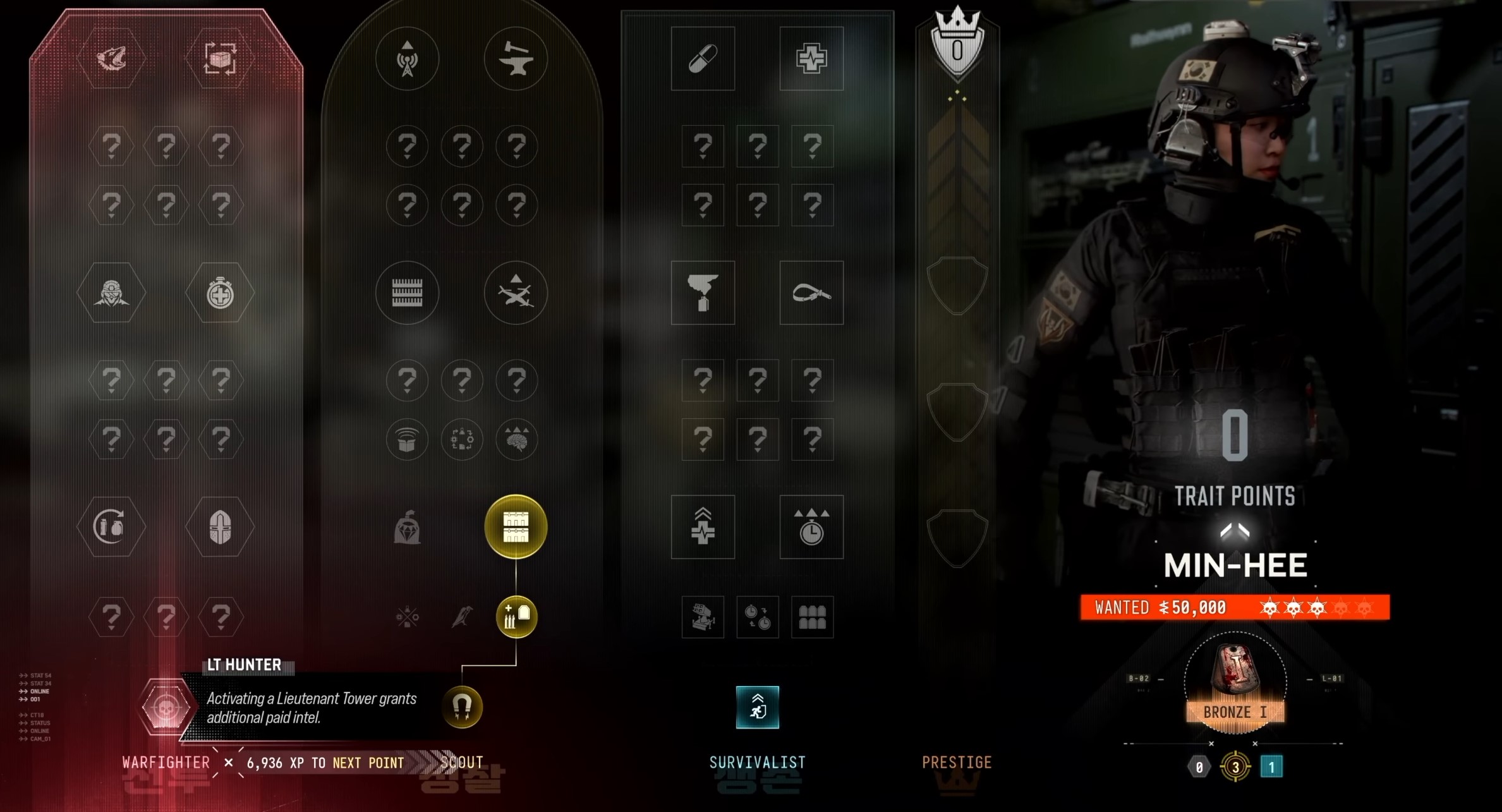
Operators have up to 18 Trait Points to spend across Warfighter, Scout, and Survivalist. Those points can only be spent on the tree of the Operator who earned them. With this system, you can have different operators for different types of gameplay - for example, a separate looting specialist and a separate combat operative. Think about what you’ll use each Operator for before committing points.
When an Operator is eliminated and becomes MIA, you can pay DMZ Cash to recover them with their Traits intact. Their equipment doesn’t come back, and the more Traits unlocked you have on that operator, the more you’ll have to pay. Sometimes, dismissing them is the alternative, but read what you’re giving up before doing it.
How DMZ Operator Prestige Works
Once an Operator earns 18 Trait Points, they can Prestige. You sacrifice equipment, pay Cash, and reset their Traits in exchange for a random permanent Prestige Trait. The first three Cash requirements are 200,000, 300,000, and 500,000, with tougher gear requirements as you climb. An Operator can hold three permanent Prestige Traits.
I like having a long-term target beyond just stacking your Stash, but Prestiging is actually pretty expensive. So hitting the requirement doesn’t automatically mean you have to do it right away.
Hajin Areas to Learn First
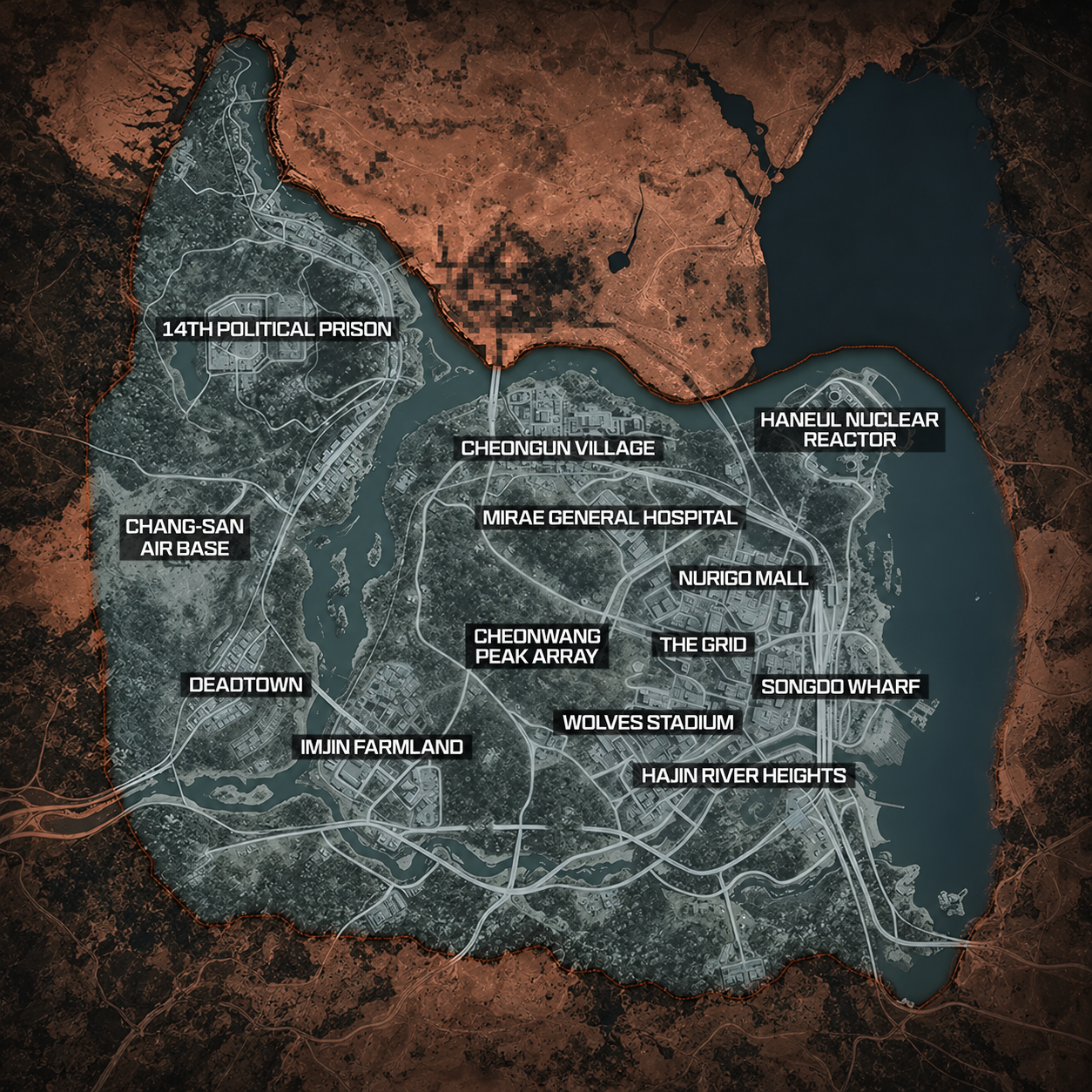
In your first runs, start with an area closest to you, loot, and try to extract - learning one area at a time is the safest tactic. AI threat indicators are a decent way to tell if the area is dangerous or not - even if you’re dealing with AI with ease, their sheer number and the time it takes to kill them all make 3rd party changes high. Probably the best new players area to learn are:
|
Area |
Starting AI threat |
|---|---|
|
Deadtown |
Low outside; Medium in Re-Education Centers |
|
Imjin Farmland |
Low outside; Medium at the Rice Mill |
|
Cheongun Village |
Low in the village; High at Heavenly Luck Casino |
|
Chang-san Air Base |
Critical outside; Extreme in the bunker |
Keep in mind that the Low Threat doesn’t mean there’s a player camping on a roof. The rating covers AI danger; players are a separate problem, so stay alert.
Best Strategy for Your First DMZ Runs
Keep your first one or two runs short. Pick a nearby area, loot enough to get something useful out of the trip, and just learn the route to extraction. In every game, before moving off spawn, you can do a couple of useful things:
-
Open the Tac-Map. Check where you landed, the nearest landmarks, and your available exits.
-
Pick one job, a single early Order or a small supply run is enough.
-
Remember the starting position to learn possible player spawns.
Learning spawns was valuable in the original DMZ, and it’s worth paying attention to in this version. Knowing where other players can be and at what time they’ll make it to the same POI as you is a superpower that can net you lots of kills and loot. Just remember that MW4 also has paid vehicle insertions and a Cargo Plane option that lets players pick their drop location.
How to Progress Efficiently in DMZ
DMZ player progression runs to level 70. Try to stack objectives in your lobbies and actually exfil in as many games as possible. XP you earn still counts after a failed extraction, but the Manual or ingredient you dropped still needs replacing. Try to build your sessions around this:
-
Before the raid: Check Orders and pin the ingredients for your next craft.
-
Early in the raid: Loot supplies and complete objectives that fit your route.
-
After a good find: Check the exit before taking another detour.
-
Back at the FOB: Unload, craft, replace what you used, and save some Cash.
Pay attention to why a run failed. If you got caught looting a body, fix that habit of looting too soon. If you ran out of supplies halfway across Hajin, shorten the next route, or get more the next time.