
Diablo 4 Horadric Cube Crafting Guide TL;DR
-
The Horadric Cube is a major Diablo 4 crafting system used to modify, reroll, upgrade, and transform gear. You unlock it after finishing the Lord of Hatred campaign and completing its related quest.
-
Cube recipes are split into Gear Modification and Item Transmutation, covering affix changes, rarity upgrades, Unique crafting, Runes, Charms, and gems.
-
Primordial Dust is the main crafting material, while Tuning Prisms help push recipes toward specific affix types.
-
Transfigure Item is powerful but risky, since it can make the gear Unmodifiable and block future crafting changes.
-
The best early recipes are Add Affix, Focused Reroll, and Upgrade to Legendary, while Amalgamation is needed for Horadric and Flawless Horadric gems.
Missed out on discontinued cosmetics and battle passes? There are lots of Diablo 4 accounts for you to browse on Playhub. Secure delivery from trusted sellers with every order.
How Horadric Cube Works in Diablo 4
Horadric Cube is an artifact of Horadrims (duh) that’s used to change the properties of an item. In Diablo terms, it means that you’ll use it to make your gear stronger. There are many features added to Diablo 4’s version of the Horadric Cube, way more than those present in previous iterations of the franchise. In this article, I cover all of them. First, let me explain how the Horadric Cube works in Diablo 4:
-
Open the Horadric Cube menu
-
Choose from the right the recipe that you need
-
Add all needed ingredients
-
Press “Transform”
One of the more important changes in Diablo 4, and perhaps one of the main reasons to use the Horadric Cube, is the fact that all items can now drop with Greater Affixes and even come out as Ancestral. Yes, even Common items. With the Horadric Cube, you can transform and transmute these items to create your own perfect roll, aka godroll, aka Best-in-Slot gear, which is much more respectful to our time.
How to Unlock Horadric Cube in Diablo 4
If you wonder how to unlock the Horadric Cube, you just have to finish the expansion’s campaign and do a short quest that will reward you with the Cube. After that, you get unlimited access to one of the best features of the new expansion.
All Horadric Cube Recipes and Materials in Diablo 4
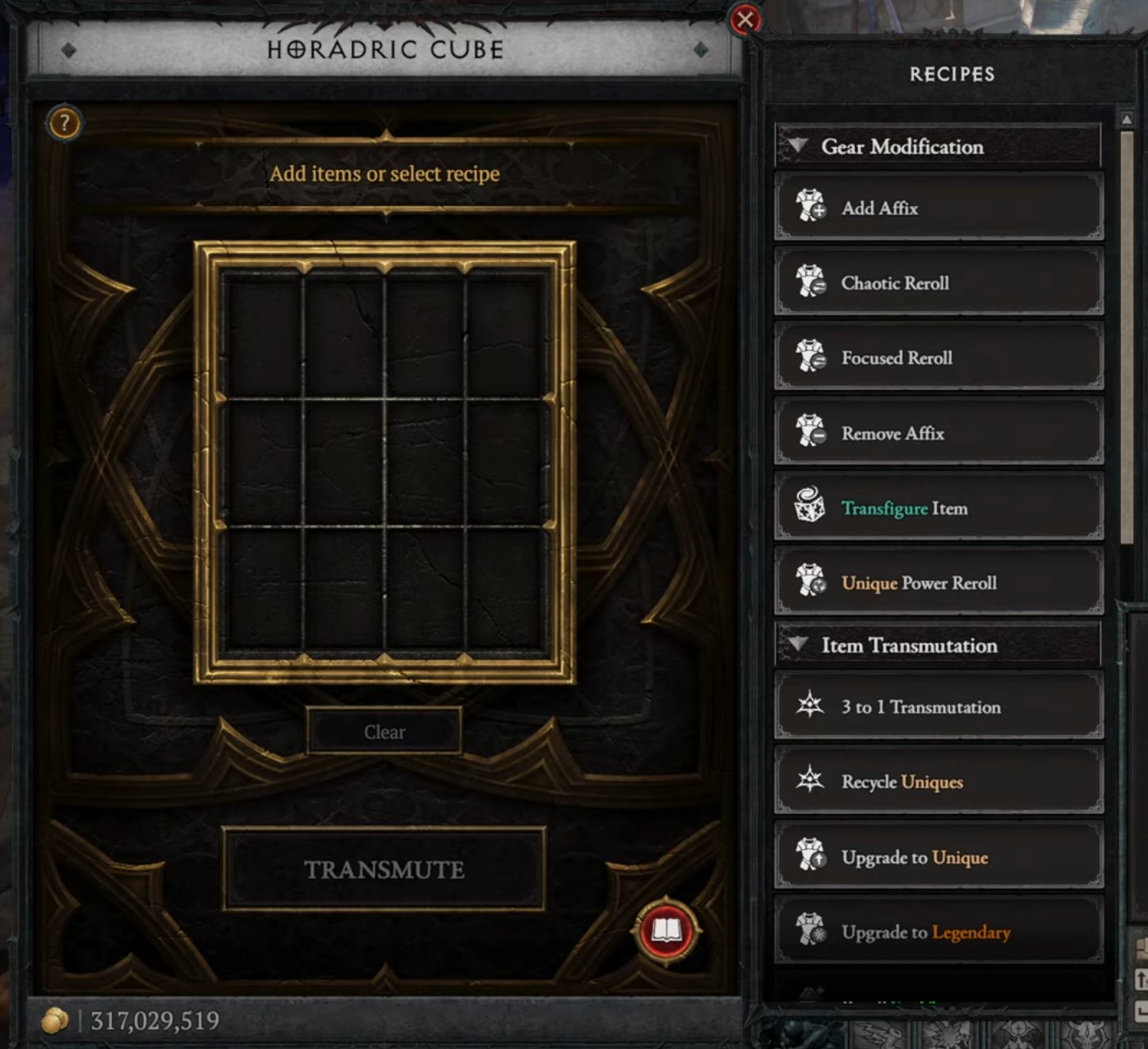
The famous artifact brings a lot of new materials to the game, which means more reasons to farm. Even though you unlock the Horadric Cube after the expansion’s campaign, once you do that, it becomes available on your new characters. If you don’t do the story, that is. Despite the Horadric Cube being such an important part of the endgame, it’s not exclusive to it. The materials you need to transform your items will drop throughout the game, letting you find a cool stick and stick to it till you kill Uber Lilith. There are two types of recipes in Horadric Cube:
-
Gear Modification: Adding, removing, changing, and substituting the affixes of an item.
-
Item Transmutation: All about item transformation. Crazy robust system that lets you push the potential of your gear into the stratosphere.
During the whole game, you’ll be constantly switching between the recipes from these two categories. You can check the entire live list on Wowhead. They do not lose their importance at any stage, whether it’s an early game or endgame. You are only limited by the resources and materials that you need for those recipes. Here’s a list of materials for the Horadric Cube in Diablo 4:
-
Primordial Dust: Cube spoils from the War Plans, Tree of Whispers caches, and Elite Monsters. Undercity is in the tier of its own when it comes to farming Dust, since you can control the drops through bargains. There are seven types of dust: Raw, Coarse, Refined, Volatile, Attuned, Enhanced, and Pure.
-
Infused Horadric Resin: Acquired from salvaging the Charms and Seals.
While the Primordial Dust is the basis of any recipe, the Tuning Prisms are the spices. They are mostly an optional material that’s needed to dish out specific affixes from the item modification and transmutation. They are more than just another material, so that’s why I made a full list of Tuning Prisms in Diablo 4:
-
Aggressive Tuning Prism: Increases the chances of an item getting an Offensive affix.
-
Adept Tuning Prism: Increases the chances of an item getting a Skill and Core stat affixes.
-
Chromatic Tuning Prism: Increases the chances of an item getting a Resistance affix.
-
Pragmatic Tuning Prism: Increases the chances of an item getting a Mobility and Utility stat affixes.
-
Protector’s Tuning Prism: Increases the chances of an item getting a Defensive affix.
There are two extra rare Tuning Prisms that do not influence affixes, but instead do something completely different. You use them for Transfiguration, which is basically Sanctification from the previous season, with the same limitation of an item having a chance of becoming Unmodifiable:
-
Entropic Tuning Prism: Evens out the rolls on the item by removing the riskiest and the most powerful outcomes. Has a 100% chance to turn the item into an Unmodifiable one.
-
Kullean Tuning Prism: Only usable on amulets. Adds two Legendary affixes to the Legendary amulets or one Legendary affix to the Unique Amulets. Leaves the item Modifiable.
Finally, we have Runes, which are like the Rune Words from Diablo 2. They already made their appearance in Diablo 4, and in this season, they can be crafted in the Horadric Cube. All Runes require similar materials:
-
A specific named Magic rune
-
Rare Runes x5
-
Legendary Invocation/Ritual Runes x5
Runes let you add powerful features to your gear, akin to legendary affixes, but from a different pool. If you apply them to your Unique gear, your build can go from unstoppable to outright broken.
Gear Modification
Add Affix: Lets you add affixes on Common, Magic, Rare, or Legendary items. Most items lock on 4 affixes tops. You can narrow down the affixes by placing a Tuning Prism along with other materials. Materials: Common, Magic, Rare, or Legendary Item x1; Coarse Primordial Dust x1; Raw Primordial Dust x5; Optional Tuning Prism.
Chaotic Reroll: Something similar to what you could do in Diablo 3 with the help of Myriam. You can choose one of the affixes and reroll it to one of the other affixes of a random category. You'll be given a few options that are randomized. Materials: Magic, Rare, or Legendary Item x1; Refined Primordial Dust x1; Raw Primordial Dust x15; Optional Tuning Prism.
Focus Reroll: Pretty much the same as Chaotic Reroll, with the key difference being the ability to reroll an affix to another affix of the same category. For instance, rerolling crit chance to a crit damage bonus. Materials: Magic, Rare, or Legendary Item x1; Refined Primordial Dust x1; Raw Primordial Dust x15; Tuning Prism x1.
Remove Affix: My most expected feature is that you can remove any chosen affix that you don't want on your item. This can come in handy when you get a good drop, but one or more affixes are standing in the way of it being a godroll. Materials: Magic or Rare item x1; Refined Primordial Dust x1; Raw Primordial Dust x15; Optional Tuning Prism.
Transfigure Item: Mostly an endgame feature that lets you modify an item in powerful ways. For instance, you can add extra legendary affixes on amulets, using a Kullean Tuning Prism. Other items don't get such powerful treatment, but instead can be improved in other ways. Think of it as Sanctification from the previous season. The item has a high chance to become unmodifiable, meaning you won't be able to make any changes to it. Materials: Legendary, Unique, or Mythic Item x1; Volatile Primordial Dust x1; Optional Tuning Prism.
Unique Power Reroll: Lets you reroll the range of effectiveness of a unique affix. Basically, if you get a unique drop that has perfect stats but the unique affix is quite weak, you can reroll this affix and get the same but stronger (or weaker) one.
Item Transmutation
3 to 1 Transmutation: Put in three items of some type and exchange them for a random item of the same type.
Recycle Uniques: Put in three Uniques and transform them into a new version of that Unique. Be mindful that the new Unique will not necessarily be better than the transmuted ones.
Upgrade to Unique: Put in a common item and upgrade it to a unique. Useful for target farming.
Upgrade to Legendary: Put in a rare item and upgrade it to a legendary one.
Reroll Set Charm: One of the most useful features of the Cube. If you have a few set charms that you don't need, or perhaps duplicates of the same set charm, you can reroll them here and get another random set charm.
Craft Unique Charm: Insane feature that lets you transform three unique charms and one ancestral unique into one charm that has the unique affix of that ancestral unique. Say unique 10 times.
Amalgamation: Put in 5 consumables, socketables, boss keys, or Nightmare dungeon sigils to create an upgraded version of them. One thing to note is that Amalgamation is your only path to the two new gem tiers - Horadric and Flawless Horadric gems - which the Jeweler can't craft.
Best Horadric Cube Recipes to Use First
If you are just starting with the Horadric Cube, you’re probably at the beginning of the grind, so focus on recipes that improve the items you already have:
-
Add Affix is great for unfinished items
-
Focused Reroll helps clean up weak stats
-
Upgrade to Legendary is useful when you have a strong Rare base
Save Transfigure Item for later, because it can ruin your future crafting plans entirely.