
Diablo 4 Paragon Guide TL;DR
-
Paragon unlocks after reaching level 70 in Season 13, then becomes your main long-term character progression system.
-
Paragon Boards are built from normal nodes, magic nodes, rare nodes, Glyph sockets, board gates, and Legendary nodes.
-
Glyphs are one of the most important parts of the system because they scale with nearby nodes and gain more power as you level them.
-
Glyphs are upgraded through The Pit, with higher Pit tiers giving more Glyph experience after completion.
Missed out on discontinued cosmetics and battle passes? There are lots of Diablo 4 accounts for you to browse on Playhub. Secure delivery from trusted sellers with every order.
How to Unlock Paragon in Diablo 4
You unlock Paragon once your character reaches Level 70. From that point onward, you continue earning Paragon points instead of regular skill points. Those points are spent on Paragon Boards, which sit outside your skill tree and give your character long-term passive power. Once you hit Paragon, the board becomes your next major project.
Your first Paragon points will not make the build explode instantly - you’ll have to path through the board to get to special sockets and nodes.
How the Paragon Board Works
Paragon Boards are large grids of nodes - think of them as a standard skill tree, just way uglier IMO. You start on your class starting board, then path outward by spending points one node at a time. Once you reach a board gate, you can attach another board and keep expanding. The board has several node types:
|
Paragon Piece |
Effect |
|---|---|
|
Normal nodes |
Small stat boosts, they’re mostly used for pathing |
|
Magic nodes |
Slightly stronger bonuses, usually grouped near the rare nodes, could actually be important for scaling |
|
Rare nodes |
Bigger bonuses with extra requirements |
|
Glyph socket |
It’s where you place a Glyph |
|
Legendary node |
Build-defining passives |
|
Gate node |
Lets you attach another board to expand your build |
Early on, do not overfill the first board just because it is there. Get what matters, then move towards the legendaries - that’s where the sauce is. A planned route that reaches your first Legendary node is usually better than spending ten extra points on weak filler nodes.
Paragon Glyphs Explained
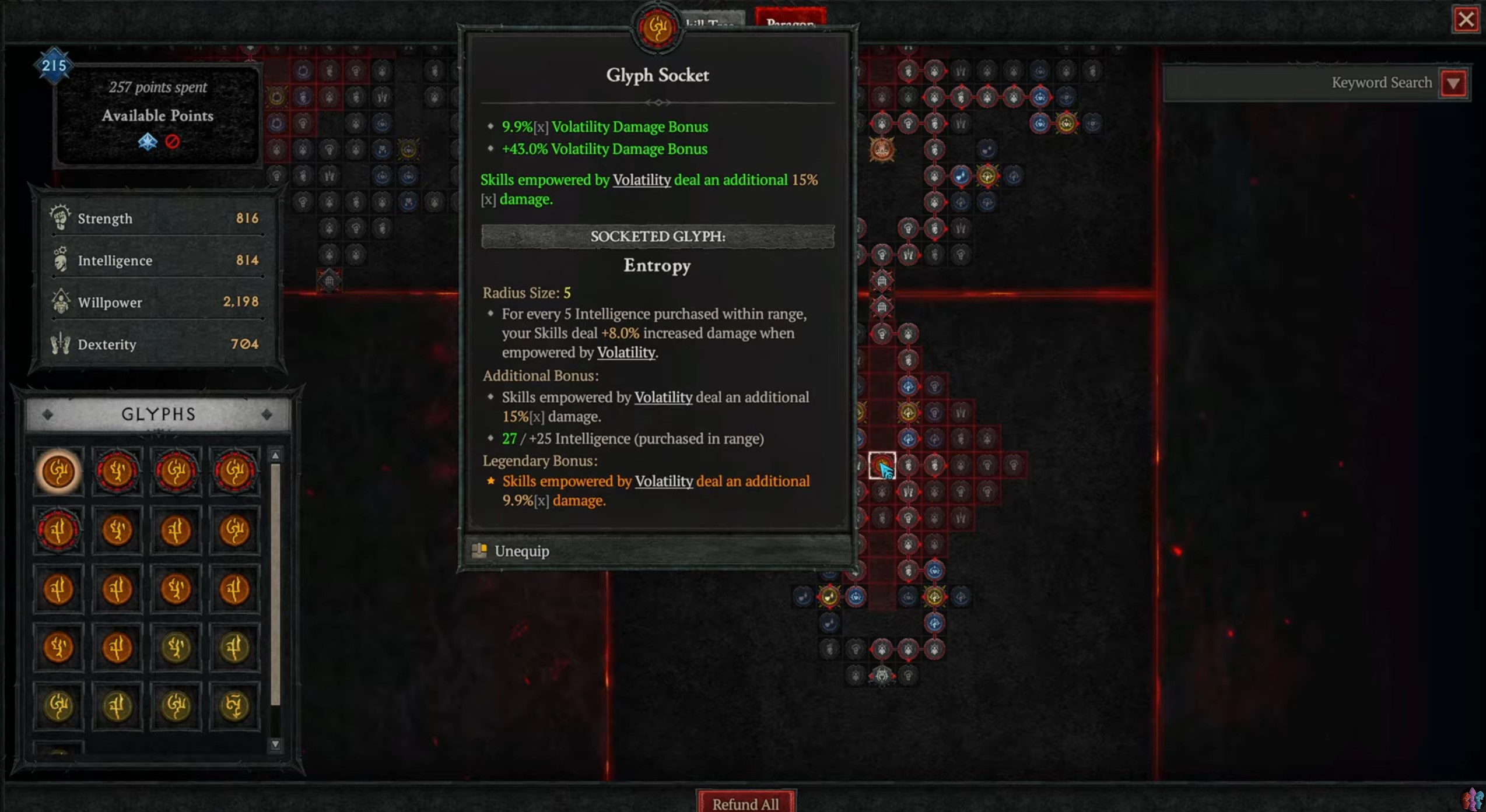
Glyphs are special items that go into Glyph sockets on your Paragon Boards. They are one of the strongest parts of the whole system - they scale from the nodes around them and can add special bonus effects when their requirements are met. You get access to Glyphs once you reach Level 70, and you can freely remove or replace them from the board without any fee or penalty. That makes them easy to test and swap in and out as your build progresses and changes.
Glyph radius is a major part of board planning. A Glyph starts with a radius of 3, grows to 4 at Level 15, and reaches 5 when it upgrades to Legendary at Level 50. That radius increase can make a socket much better because it lets the Glyph count more nearby nodes.
How to Level Glyphs in Season 13
In season 13, Glyphs are now leveled exclusively through The Pit. After finishing a Pit run, you apply experience to your Glyphs. After completing a Pit run, you get 3 Glyph upgrade attempts. If you finish the run without dying, you get 1 extra attempt, giving you 4 total upgrades from a deathless clear. Higher Pit tiers equal more Glyph experience, so pushing higher tiers is the main way to speed up your Glyph progression.
Glyphs also gain radius as they level, which lets them reach more nearby nodes. For Season 13, use Level 50 as the important Legendary/radius breakpoint unless your in-game tooltip says otherwise.
Do not spread experience too thin early, though. One high-value Glyph leveled to 15 is usually better than five underleveled Glyphs doing very little, so it’s important to understand what your build actually needs.
Fast Paragon Leveling in Diablo 4 Season 13
Fast Paragon leveling in Season 13 is mostly about stacking XP sources. Sure, you can run random activities you enjoy, but here’s the optimal, most efficient way to level your Paragon:
-
Play the highest Torment tier you can clear quickly, emphasis on speed - you should be able to clear everything without any problems. You can be able to clear Torment 12, but Torment 10 can be more efficient if you clear it much faster.
-
Check your Whispers before choosing to run any activity. A relatively weak activity becomes worth doing if it gives quick Grim Favor progress.
-
Line up the War Plan steps with the activities you already want to run. War Plans give XP as you complete steps and a bigger payout when you finish them.
-
Run Undercity with Growth Tributes whenever you have them. This one’s your best burst XP option - the tribute adds a huge XP orb reward at the end.
-
Farm Helltide when Blood Maiden, portals, Whispers, or War Plan objectives line up together.
-
Use 10-wave Infernal Hordes for steady XP. It is not as bursty as Growth Tribute Undercity, but the enemy density is high, and you do not waste time traveling.
-
Run The Pit when your Glyphs need upgrades. It is not the best raw Paragon XP farm, but Glyph levels are too important to skip out on.
-
Kill Lair Bosses only when they are tied to Whispers or War Plans. The boss kill alone gives poor XP, but the whispers objective payout makes it worth the quick stop.
The best choice you have is Undercity with Growth Tributes, Helltides, 10-wave Infernal Hordes, and Pit runs for Glyph levels. Just make sure to keep Whispers and War Plans layered over those activities whenever possible.
Paragon Changes in Diablo 4 Season 13
I think it’s worth mentioning that the Paragon system matters even more since Season 13 changed the role Paragon plays in your build. The power distribution has changed significantly - passive power and scaling options have moved from the skill tree to the Paragon, so the board grind is even more important for power gains than ever before.
This also explains why the new skill trees feel much more focused on active skill choices, and nothing besides that. The skill tree now decides what your build does, and Paragon is responsible for the endgame scaling. If your Paragon board is weak, your build can feel trash even if your gear and skills are good.
Season 13 progression also gives Paragon more importance outside normal leveling. The new Seasonal Rank system can reward extra Paragon points, tying activities and goals together. So the system is largely the same, but its impact on your power level has increased. Here are the full patch notes.