
Valorant evolves continuously, with new agents, balance updates, and strategies shifts. In 2026, the game includes a massive roster of 28 playable agents. Each agent brings a unique mix of unique utility, firepower, and strategic depth. However, not every agent performs equally well across maps, ranks, and team compositions. This Valorant agents tier list ranks all 28 agents by general utility, consistency, flexibility, and how forgiving they are when playing solo queue or random matches.
We judge agents based on their ability to influence rounds: creating space, gathering intel, winning duels, clutch potential, and safe fallback utility. The best agents offer impact even when teammates misplay or communication breaks down. The weaker ones tend to rely on perfect timing, deep coordination, or specific maps. Use this list as a rough guide. Skilled players can make almost any agent shine.
Missed out on some of the previous battle pass skins? You can buy Valorant accounts with any skins you want on Playhub. Quick delivery and lots of offers to choose from.
Valorant Tier List Explained
Instead of just listing agents from top to bottom, it’s important to know how each tier is defined. Being in a lower tier doesn’t mean that an agent is useless - every character has maps and compositions where they can perform well. Our Valorant tier list rankings reflect characters’ consistency and general effectiveness.
-
S-Tier (Meta Defining)
These agents perform well in nearly every map, rank, and team composition. They bring utility that translates directly into round wins, support both aggressive and defensive playstyles, and work just as well even in poorly coordinated matches.
-
A-Tier (Strong and Reliable)
These agents are powerful but need a bit more team support, map knowledge, or awareness to unlock their full potential. They still remain great picks for ranked and climb well in most hands.
-
B-Tier (Situational or Map-Dependent)
Valorant agents ranked in this tier can be strong depending on the environment or the player’s comfort. Some are specific map specialists, others thrive only with good setups or teamwork. They perform well when the required conditions align, but they are too inconsistent in general play.
-
C-Tier (Niche Picks)
These agents tend to be specialized, unforgiving, or overly dependent on team coordination. They can still dominate in the right hands, but they require more planning and experience to perform consistently.
Valorant Characters Tier List
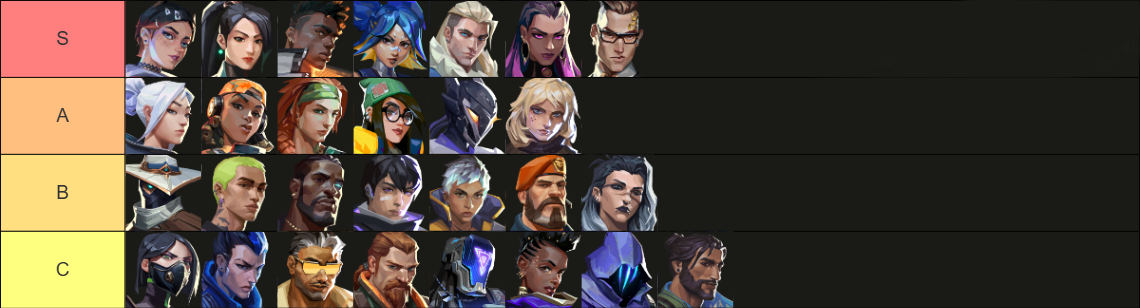
We’ve categorized agents based on the community’s opinion and pro play stats. Here’s a readable Valorant characters tier list table with a full breakdown of the current meta:
|
Tier |
Agents |
|---|---|
|
S-Tier |
Clove, Sage, Phoenix, Neon, Sova, Reyna, Chamber |
|
A-Tier |
Jett, Raze, Skye, Killjoy, Vyse, Deadlock |
|
B-Tier |
Cypher, Gekko, Veto, Iso, Waylay, Brimstone, Fade |
|
C-Tier |
Viper, Yoru, Tejo, Breach, KAY/O, Astra, Omen, Harbor |
This breakdown provides a quick way to understand how each agent performs in standard matches. Even though higher-tier agents are more universally reliable, every character remains viable with the right playstyle and map. Tier list is simply a broad snapshot of the current meta rather than a strict restriction on what is playable or competitive.
S-Tier Agents
Clove is arguably the best agent in Valorant thanks to her perfect blend of reliability and flexibility. Her abilities offer consistent value on attack and defense, whether executing site takes or locking down flanks. Even when rounds go chaotic, Clove maintains control. She does not require intensive coordination, which makes her ideal for solo queue and mixed-skill parties alike.
Sage remains a powerful choice in 2026. Her healing, revive, and wall-utility give her huge leverage in clutch situations and during defensive holds. When a round goes sideways, Sage’s survival tools often swing the balance back. Her presence adds stability and endurance to any team.
Phoenix remains among the most dependable duelists. His toolkit gives him self-sustain and flexibility, making him effective in entry roles or mid-round scrambles. His flashes and healing let him fight aggressively and retreat safely. For players who value consistency over high-risk plays, Phoenix is one of the top Valorant agents.
Neon’s mobility and speed make her one of the most dynamic duelists. She excels at fast pushes, surprise entries, and disrupting defensive setups before they solidify. When timed correctly, Neon can force defenders into making mistakes and create openings. Her value rises with aggressive, confident play.
Sova’s recon and intel-gathering remain invaluable across all ranks. His arrows and drone give teams early information, prevent rushes, expose hiding defenders, and offer clutch post-plant insight. Even with modest aim, a good Sova player helps the team make smarter decisions and avoid blind engagements.
Reyna’s playstyle rewards fraggers and confident aimers the most. Her self-healing after kills and clutch potential make her fearsome in one-on-one fights or when snowballing momentum. In solo queue, Reyna often carries rounds just with duels and self-sustain. She demands aim and game sense, but pays off when used well.
Chamber blends sentinel-level scouting and safety with duelist potential. His traps and armor ability add defensive strength, while his weapon-enhancing tools reward precise positioning and aim. For players favouring flank defense playstyle, Chamber remains the ultimate answer to the question of who is the best agent in Valorant.
A-Tier Agents
Jett continues to be a solid duelist, especially when used by sharp aimers. Her dash and reposition tools give her the flexibility to challenge aggressive angles or escape bad fights. She remains especially dangerous on open maps or when sniping angles. But her reliance on mechanical skill and reflexes makes her a bit less forgiving than other top picks.
Raze thrives when teams want aggression and chaos. Her explosives, mobility, and space-clearing tools punish entrenched defenders and clear common hide spots. On tight maps or entry-heavy plays, Raze is a good pick. She’s less consistent in slower rounds or when rounds emphasize control over fragging.
Skye’s utility works well for flexible and adaptive strategies. Her flashes, healing, and scouting abilities help in both offense and defense. In coordinated play, she amplifies team performance. In solo queue, timing and awareness matter a lot, but in the right hands, Skye is one of the best Valorant characters.
Killjoy excels at locking down sites and delaying enemy pushes. Her traps and gadgets are strong tools for post-plant defense and area denial. On slower maps or when expecting predictable enemy movement, Killjoy performs well. Her usefulness drops if opponents play unpredictably or rush aggressively.
Vyse brings creative utility and map pressure potential. Her tools support both defense and offense, especially when combined with good team play. She belongs more to specialized comps than general picks. But for players willing to learn timing and utility patterns, she offers a balanced but flexible option.
Deadlock’s control tools punish reckless pushes and funnel enemies into predictable paths. She is especially useful on defensive sides and coordinated plays. Her limitations show on chaotic rounds or when enemies adjust quickly. As a situational anchor, Deadlock offers value - but depends heavily on reading enemy behavior.
B-Tier Agents
Cypher retains value as a defensive sentinel. His cameras and traps offer information and space control. However, in the current Valorant meta, he becomes less effective against walkers that avoid standard angles or when enemies play highly unpredictably. Cypher works best when rotations are slow, and maps favor chokepoints.
Gekko offers players a kit filled with versatile utility that supports site pushes, retakes, or defensive setups. His creatures can scout or flush out enemies. However, his tools require coordination and timing, making him inconsistent in solo queue. In structured play, he performs decently, but he lacks ultimate reliability compared to top-tier initiators or controllers.
Veto is a newer sentinel with utility leaning toward clutch plays and round resets. He can adapt to multiple roles, which gives him flexibility. However, because players are still learning his kit, his consistency is lower. Over time, with experience, Veto may climb higher - for now, he is best in the hands of seasoned players.
Iso works best in the hands of confident fraggers. His duelist-style play rewards aim and good positioning. He sometimes struggles outside that comfort zone, especially in utility-heavy or coordinated fights. Iso remains viable, but for players comfortable with gunplay more than ability reliance.
Waylay blends aggressive potential with tactical utility. His kit supports flanks, pressure plays, and utility disruption. His ability to surprise opponents and shift momentum makes him good against some of the Valorant meta agents. But since his behaviors rely on timing and info gathering, Waylay is less forgiving than many core agents. He performs better in organized squads than in solo queue.
Brimstone remains a straightforward controller. His smokes and area control are easy to use and effective at blocking angles or securing site entries. While not flashy, he continues to provide value for players preferring consistent, simple strategies. He doesn’t scale as much as newer controllers but stays reliable for structured approaches.
Fade’s recon and crowd-control utility can be extremely strong when used with the right timing. She can clear corners, flush out defenders, and provide setup information for both site takes and retakes. Her problem isn’t power but reliability. Fade relies heavily on team follow-up and communication. When coordination is good, she performs closer to an A-tier initiator. In solo queue or messy rounds, her tools lose a lot of impact. Fade demands strong reads, patience, and communication, which is why she sits in B-Tier despite having a very high ceiling.
C-Tier Agents
Simply put, in 2026, Viper is not the best Valorant agent. Her strengths lie in area control and denial. On maps that reward slow plays and tactical pushes, she can control choke points and delay enemy movement. But in fast-paced, chaotic matches, her impact drops. She demands patience, map awareness, and team coordination to perform well.
Yoru thrives on surprise, deception, and unorthodox plays. He can lurk, flank, and create confusion among defenders. But those same traits make him unpredictable and often unreliable in standard competitive settings. Without coordination and intention, Yoru’s value suffers dramatically.
Tejo offers high utility and potential for creative plays. His toolkit supports both aggressive takes and defensive control. However, he demands strong game sense, map knowledge, and coordination. In casual or unpredictable matches, he is often outmatched by agents with simpler, more direct kits.
Breach excels at disruption and clearing sites when teammates follow through. His flashes and crowd control help break setups or force defenders out. Still, since his utility affects both enemies and teammates, badly timed abilities can backfire. He requires coordination and awareness, which lowers his consistency in mixed-skill games.
KAY/O can cripple ability-reliant enemy teams and give an edge to gunfight-heavy lineups. He is effective against high-utility compositions. But if opponents rely on raw aim and movement rather than abilities, his strength diminishes. He is a strong counter-pick tool but not a universal solution.
Astra is one of the most strategic controllers, with a global-scope utility that can shape entire rounds if used well. But she demands high situational awareness, map control, and communication. In the present Valorant meta, she often underperforms because her toolkit is too complex and timing-sensitive.
Omen brings valuable smoke, reposition, and utility disruption tools. He works well for flanks, fakeouts, and flexible plays. However, his effectiveness depends heavily on timing and team support. In fast-paced or poorly coordinated games, he tends to lose value compared to more straightforward controllers.
Harbor’s wall and water-based utility offer structure for planned executes or site control. He can block lines of sight and aid in pushes. But his kit is slow and predictable, making him less effective in dynamic fights or against aggressive enemy strategies. His potential remains high for teams willing to commit to coordinated plans, but in typical matches, he struggles.