
FC 27 Clubs Guide TL;DR
-
Clubs are now placed inside The Grounds, a shared football world HUB for up to 100 players.
-
Every Archetype is available from the start in FC27, and rebuilding a Pro no longer costs Coins.
-
Masteries are set to reward long-term progress across different Archetypes, and the Amps system gets you powered up with temporary match bonuses.
-
Leagues and Playoffs return alongside new 11v11 Club Tournaments.
-
Shared Club Objectives let the whole squad contribute toward seasonal rewards.
-
Clubs is available on all current-gen platforms - PS5, Xbox Series X|S, PC, and Nintendo Switch 2.
Still haven’t bought your FC 27 copy, or looking into getting started on another platform? You can get an FC 27 accounton Playhub - best prices and quick delivery from verified sellers on every order.
What Are Clubs in EA Sports FC 27?
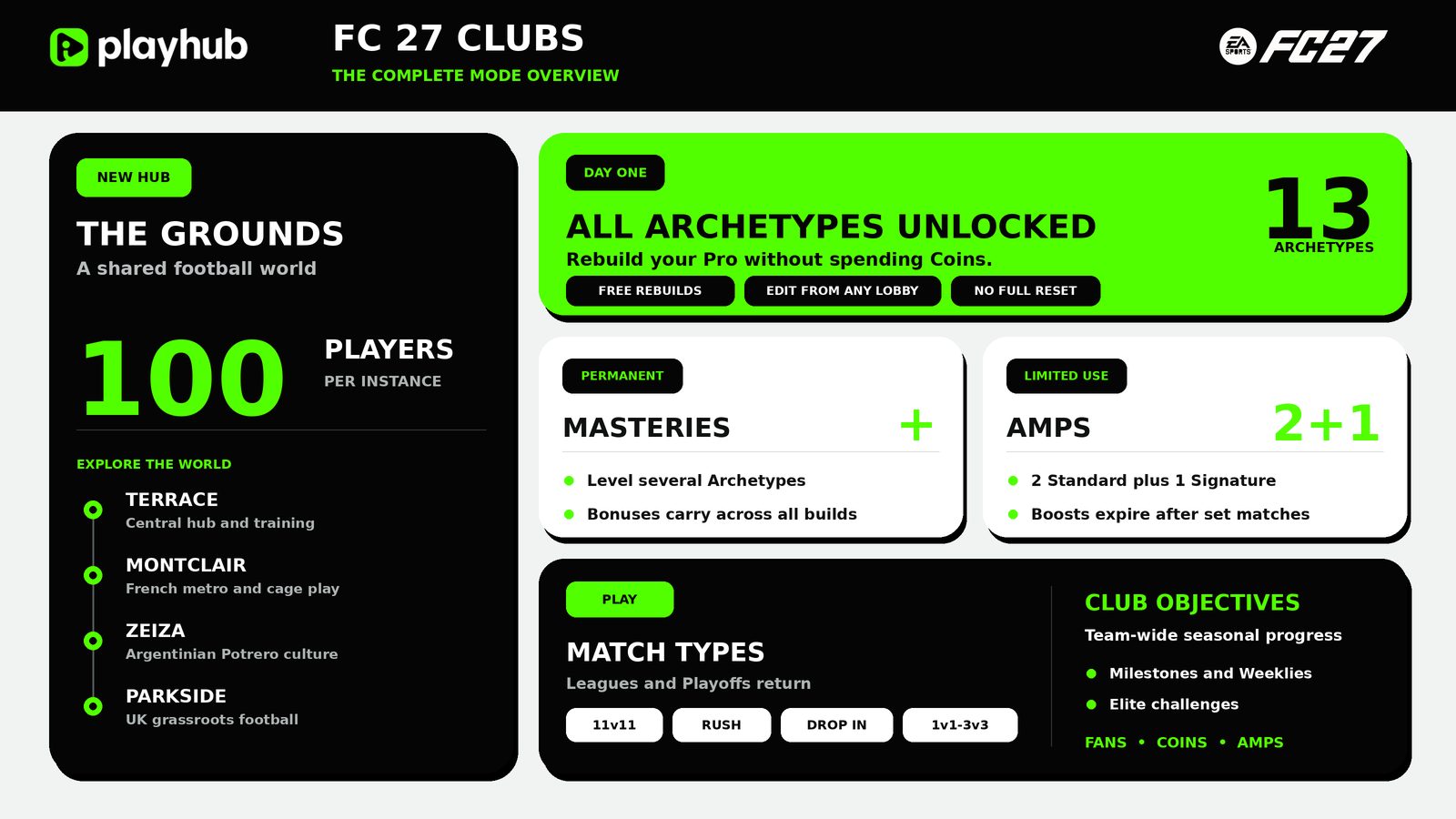
Clubs is FC 27’s team-based online mode. Each person controls one custom Virtual Pro, so a good match depends on each player’s performance. Players create or join a club, choose positions, and compete against other teams. The biggest change compared to the previous franchise entries is that FC 27 moves that loop into The Grounds, a shared HUB consisting of three districts and a central Terrace. EA says one instance can hold up to 100 players in its official Grounds and Clubs Deep Dive.
Besides the Clubs, the Grounds adds social areas, street football, etc., all centered around the competitive mode. I see it as a big departure from FC 26’s basic menu-led structure, and the game moving forward towards a modern experience. Besides that, some of the bigger changes include QOL stuff like Archetypes being easier to rebuild, and limited-use Amps creating another layer of freshness in your comp games.
How to Create or Join a Club
Since Clubs are in the Grounds now, you need to head to the Clubhouse and open the Clubs area. From there, a manager can create a club and choose its name, abbreviation, colors, kit, crest, and stadium identity.
Personally, I think that joining an already established club is easier; just find an active community, maybe the one started by your favorite streamer or such. Search for its name or accept an invitation through an EA ID. You can also access a regular squad and use Stadium Drop In for skill-based 11v11 or Rush matchmaking without joining one.
FC 27’s The Grounds and Clubhouse Explained
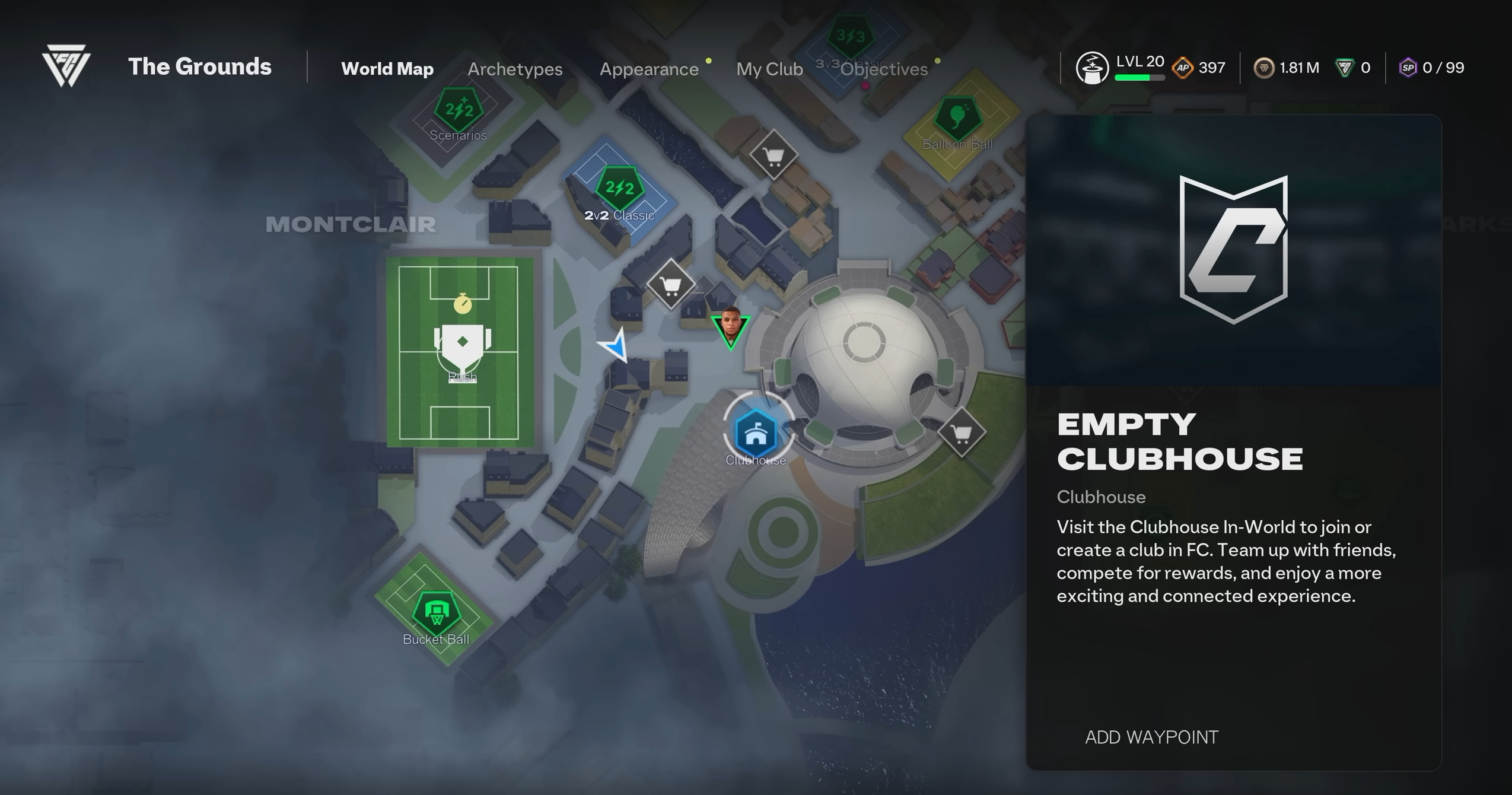
The Terrace acts as the central meeting point in The Grounds, and also a training facility. It connects the Clubhouse with three themed districts and contains the main Grounds Store. Players can meet there, check the available activities, or move straight toward the mode they want. The Clubhouse leads into competitive matches; you can actually see its entrance and stadium presentation reflect the club’s identity, which is certainly cool. Thematically, the three districts lean into different football cultures:
|
District |
Style |
Main Theme |
|---|---|---|
|
Montclair |
French metropolitan football |
Cage pitches and urban play |
|
Zeiza |
Argentinian Potrero culture |
Colorful neighborhood football |
|
Parkside |
UK working-class football |
Grassroots pitches and terraced streets |
Mentors introduce the development activities across these areas:
-
Alex Hunter focuses on improving the player
-
Kylian Mbappé covers agility and small-sided football.
-
Chloe Kelly handles Kickabouts and creative activities.
-
Paulo Dybala is the Clubs-focused Mentor, with activities tied to stadium events, teamwork, and loyalty.
I think that anyone who normally skips tutorials should at least try to resist that habit this year. Mentor activities should explain how FC 27’s new systems connect together, and they offer a cleaner progression route than blindly entering matches.
FC 27 Clubs Match Types

Leagues and Playoffs remain the competitive backbone of Clubs. Teams climb divisions during the season, then enter Playoffs for rewards based on their level. This is the familiar side of the mode, and it should still be where settled squads spend most of their time.
FC 27 adds 11v11 Club Tournaments as rotating Live Events. A tournament may change its round count, reward pool, or rules. Confirmed House Rules include Mystery Ball, King of the Hill, No Rules, Headers and Volleys, Survival, and Long Range. Do not walk into every event with the same league setup. A crossing team makes sense in Headers and Volleys, while Long Range gives midfield shooters far more room to matter.
Stadium Drop In offers matchmade 11v11 and Rush games. Ranked Rush and Rush Tournaments remain available through the Rush Stadium, so smaller groups are not forced to fill an entire Clubs side. These modes should also be the safest place to learn an unfamiliar build.
The Grounds itself supports shorter 1v1, 2v2, 3v3, and Rush matches. Each game lasts three minutes. The 1v1 format gives both players a CPU goalkeeper, while 2v2 and 3v3 use smaller goals without keepers. These matches are not a replacement for Clubs, but they give players something useful to do while waiting for the rest of the squad.
FC 27 Archetypes Explained
This year, Archetypes define how a Virtual Pro plays, probably more than ever. Every Archetype is unlocked from the very start. Players can also move individual attribute points without paying Coins or wiping the full build, which is huge for theorycrafting and tweaking your player whenever you feel like it. Compared with FC 26, this removes much of the pain from experimenting. Build changes are available virtually anytime - either from The Grounds menu, Clubhouse, Clubs lobby, or Rush lobby. Here are this year’s archetypes:
|
Archetype |
Natural Role |
Mastery Attributes |
|---|---|---|
|
Shot Stopper |
Traditional goalkeeper |
GK Positioning, GK Reflexes |
|
Sweeper Keeper |
Aggressive goalkeeper |
GK Handling, GK Diving |
|
Progressor |
Ball-playing defender |
Long Passing, Standing Tackle |
|
Boss |
Physical center-back |
Aggression, Strength |
|
Marauder |
Fast defensive runner |
Sliding Tackle, Sprint Speed |
|
Disruptor |
Defensive midfielder |
Stamina, Interceptions |
|
Recycler |
Possession midfielder |
Defensive Awareness, Short Passing |
|
Maestro |
Technical midfielder |
Reactions, Ball Control |
|
Creator |
Advanced playmaker |
Free Kick Accuracy, Vision |
|
Spark |
Wide creator |
Crossing, Dribbling |
|
Magician |
Agile attacker |
Curve, Acceleration |
|
Finisher |
Central goalscorer |
Composure, Finishing |
|
Target |
Physical striker |
Balance, Jumping |
Try to be flexible during matches since the team shape matters lots; you need to bring in something your composition needs. In midfield, one Disruptor usually brings more balance than stacking three Creators.
Masteries and Long-Term Progression
Masteries is a system that gives players a reason to develop more than one Archetype. Reaching certain milestones awards permanent attribute bonuses across every build. EA’s example grants +1 Finishing and +1 Composure to all Archetypes after Finisher reaches Level 10. So the game encourages you to play different builds and get masteries up to squeeze as many stats as possible.
As an example, Forwards can begin with Finisher before working on Magician and Target. Center-backs get more relevant value from Boss, Marauder, Progressor, and Disruptor. A central midfielder can pull useful Masteries from Recycler, Maestro, Creator, and Disruptor.
How Amps Work in FC 27 Clubs
Amps are power-ups that temporarily improve the active Archetype. A player can equip three at once: two Standard Amps and one Signature Amp. Unlike Masteries, these bonuses expire after a fixed number of matches.
|
Amp Tier |
Type |
Buff |
|---|---|---|
|
Tier 1 |
Standard |
Attribute boosts |
|
Tier 2 |
Standard |
Larger attribute boosts |
|
Tier 3 |
Signature |
Attributes, PlayStyles, and Perks |
|
Tier 4 |
Signature |
Attributes, PlayStyles+, and Perks |
I think that the limited-use design is a bit daunting and makes deciding when to use them important. Burning a strong Signature Amp in a casual Drop In is hard to justify when Playoffs or a difficult tournament are coming. You really have to save the better ones for matches that matter, and make sure that the effect fits the role.
Club Objectives and Rewards
Club Objectives are set in place to turn individual gameplay into group progress. They might ask for different stuff, like the squad to win five League matches together or achieve 50 total 1v1 victories. EA has confirmed three objective types:
-
Club Milestones are long-term Bronze, Silver, and Gold goals. They award Fans and improve the club’s reputation.
-
Club Weeklies and Seasonals provide rewards such as Amps, Consumables, and Coins.
-
Elite Objectives add harder goals for clubs that reach Elite Division.
This should make substitute solo grinders feel more involved in team play than they did in FC 26.
Best Formation and Team Structure
Your best club formation depends on your team player count. For four or five players, 4-2-3-1 gives the team reliable cover. Put people through the central spine first: striker, CAM, defensive midfield, and center-back. If another player joins, a winger brings more value than another attacking midfielder.
Groups of six to eight can move into 4-3-2-1 or 4-3-3. One midfielder must stay behind the ball, and both full-backs should not attack at the same time unless someone gets into their space. Full 11-player teams can press aggressively, but the back line must move in and out together. Here are the default comps:
|
Squad Size |
Best Positions |
|---|---|
|
2–3 players |
ST, CAM/CM, CDM |
|
4–5 players |
ST, CAM, CDM, CB, flexible winger |
|
6–8 players |
Central spine, both wings, one full-back |
|
9–11 players |
Every position, with a vocal goalkeeper or captain |
Check out other helpful FC 27 articles: