
LoL Classic Masteries TL;DR
-
You distribute 30 Mastery Points between the Offense, Defense, and Utility trees.
-
Most damage dealers use 21 points in Offense, while tanks usually opt for 21 points in Defense.
-
Rows unlock after every 4 points invested in the same tree, with the final Mastery becoming available after 20 points.
-
Executioner, Honor Guard, and Nimble are the final and most impactful Masteries in their respective trees.
-
You unlock every Mastery Point and page at Classic Level 4. Default non-customizable pages are available at all times.
-
The exact 21/9/0 split is less important than choosing nodes that suit your damage type, Summoner Spells, lane, and role.
Want to get to high ranks without sweating for hundreds of hours? You can get a LoL Classic Rank Boost on Playhub. Competitive prices and reliable service from trusted players with every order.
How LoL Classic Masteries Work
Runes (here’s my complete guide on them) give you raw starting stats in LoL Classic, but Masteries add another layer of smaller bonuses and passive effects for us to tweak. Instead of choosing from modern Keystones and just a handful of supporting Runes, you distribute the whole 30 points across three large trees before entering the Summoner’s Rift.
I like this RPG freedom more than I expected. Tree splits can be tweaked to your preference - you can get more mana and shorter Summoner Spell cooldowns, or go for some durability to withstand early poke. The downside is that several points of the tree really feel like a tax you pay to reach the Mastery you really want. Modern League removed a lot of that fluff when it comes to its mechanics, although it also removed the ability to spread points around this freely.
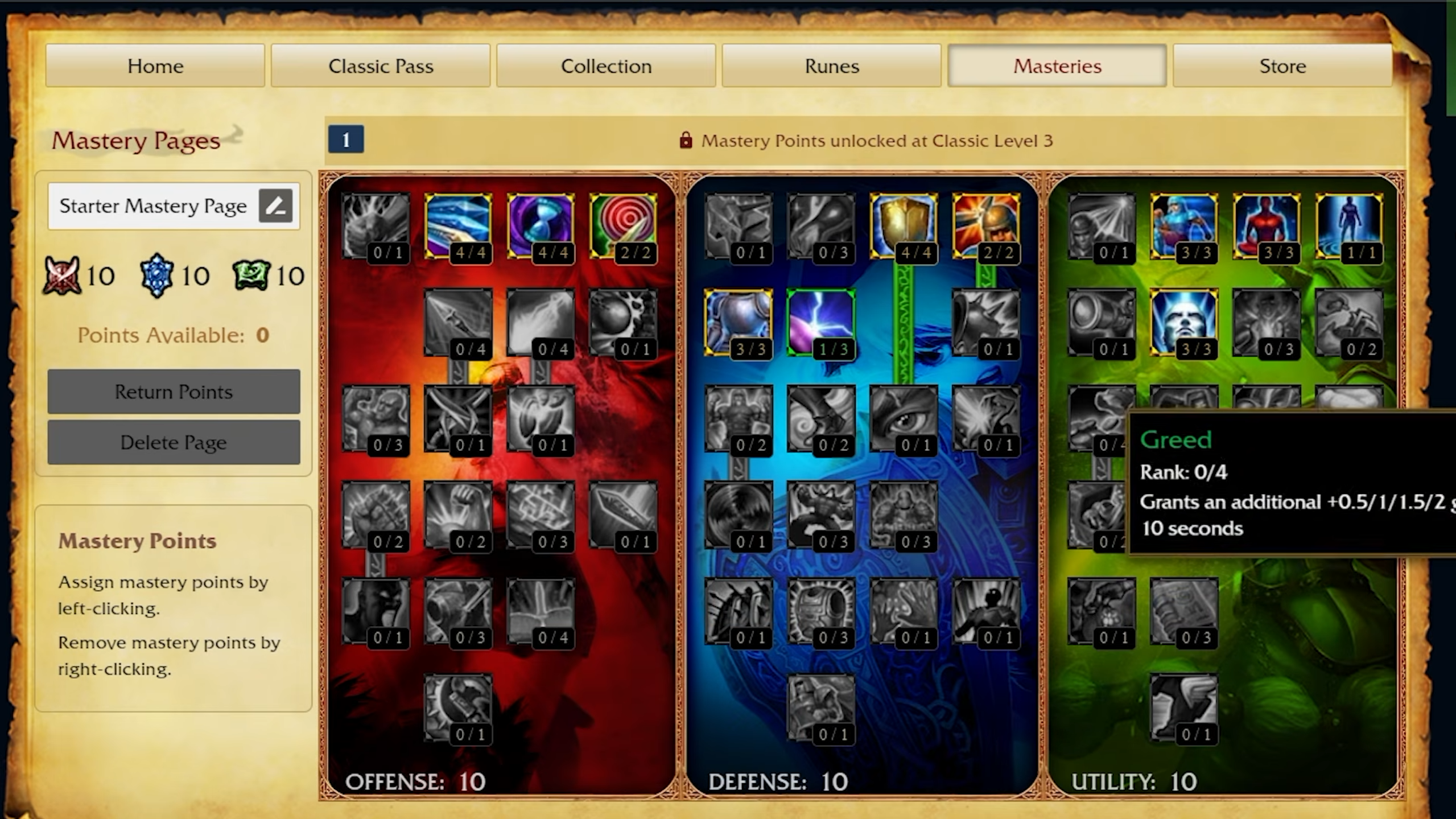
Classic Masteries fully unlock at Classic Level 4, so there is no old level-by-level grind to reach all 30 points. Riot also provides starter and default pages, which prevents a new player from entering a match with no pre-game bonuses at all.
LoL Classic has 56 Masteries divided between three trees: 18 in Offense, 19 in Defense, and 19 in Utility. Each tree has six rows, and a new row becomes available for every four points invested in that tree. Some Masteries also require the node above them to be fully ranked before they can be selected.
Offense, Defense, and Utility Trees Explained
The three trees sound simple, but each has several branches intended for different champion types. Offense focuses on increasing physical and magic damage, Defense mixes lane durability with jungle protection, and Utility contains mana, gold, vision, Summoner Spell, and Movement Speed bonuses, allowing you to opt for more of a strategic approach.
|
Mastery Tree |
Best For |
Most Important Masteries |
|---|---|---|
|
Offense |
ADCs, mages, assassins, damage-focused junglers |
Weapon Expertise, Arcane Knowledge, Sunder, Archmage, Executioner |
|
Defense |
Tanks, bruisers, engage supports, durable junglers |
Tough Skin, Bladed Armor, Veteran’s Scars, Block, Tenacious, Juggernaut, Honor Guard |
|
Utility |
Supports, mana users, roaming champions |
Mastermind, Greed, Wealth, Runic Affinity, Pickpocket, Intelligence, Nimble |
The tree also contains some distinctly old League ideas which sound pretty interesting. Spellsword adds 5% of your Ability Power as magic damage to basic attacks, while Frenzy grants 10% Attack Speed after a critical hit. They are useful on the right champion, but neither should be taken just because its description sounds exciting. Spellsword does very little for a mage who realistically rarely attacks, and Frenzy needs reliable crit rates before it starts actually doing its job well.
Utility is the strangest tree and probably the most fun to experiment with. It's stuff like starting gold, passive gold, bonus experience, Summoner Spell cooldown reduction, and Movement Speed. I think Supports get the most out of it. Greed can generate 2 gold per 10 seconds, Wealth adds up to 75 starting gold, and Pickpocket awards gold when you attack an enemy champion. Intelligence provides up to 6% Cooldown Reduction, while Nimble adds 3% Movement Speed at the bottom of the tree.
Best LoL Classic Mastery Pages
I’d recommend you prepare at least one page for every role you play regularly. Unlike Runes, Masteries do not cost IP individually, so there is no reason to force an AP champion onto an AD page right after the system is unlocked. Here is the golden standard mastery build that you can then fine-tune to your playstyle:
Standard AD Carry Masteries: 21/9/0
|
Offense |
Defense |
|---|---|
|
Perseverance: 1/3 Durability: 4/4 Hardiness: 3/3 Veteran’s Scars: 1/1 |
This is the default for champs like Ashe, Corki, Ezreal, Miss Fortune, Sivir, Tristana, Twitch, and Vayne. The 21 Offense points provide Attack Speed, scaling and flat Attack Damage, Armor Penetration, additional crit damage, Lethality, and Executioner’s finishing bonus - you’re turning yourself into an AD machine.
The 9 Defense points are there because bottom lane can get hard to contest early into the game. Veteran’s Scars adds 30 starting Health, while Hardiness gives 6 Armor at full rank, which is actually a hefty bonus to your defensives. Into a magic damage-heavy lane, I would move some Hardiness points into Resistance instead.
Standard AP Mid Masteries: 21/0/9
|
Offense |
Utility |
|---|---|
|
|
Most Mid characters are casters, so they benefit greatly from AP-oriented masteries. Arcane Knowledge provides 8% Magic Penetration, Archmage increases total AP by 5%, and the combination of Sorcery with Mastermind makes spells and Summoner Spells available more often, so I think they’re all must-haves.
Spellsword is the point I think is worth swapping often. Champions who weave basic attacks between spells get lots of value from it, but Karthus and other mages that rarely approach attack range may prefer putting that point elsewhere.
Tank Top Masteries: 9/21/0
When it comes to top lane, there are two playstyles you play most often:
AD Bruiser
|
Offense |
Defense |
|---|---|
|
Perseverance: 3/3Durability: 4/4Hardiness: 3/3Unyielding: 2/2Veteran’s Scars: 1/1Block: 1/1Tenacious: 3/3Juggernaut: 3/3Honor Guard: 1/1 |
AP Tank
|
Offense |
Defense |
|---|---|
|
|
These pages are for champions that need some lane pressure but gain more from surviving long fights than reaching Executioner. Block and Unyielding are especially good into basic-attack-heavy lanes. Tenacious reduces crowd-control duration by up to 15%, Juggernaut adds 4% maximum Health, and Honor Guard removes 3% of incoming damage from every source. Do note, though, that a passive farming matchup may allow 0/21/9 for Movement Speed or Summoner Spell cooldowns, and an aggressive bruiser may still prefer 21/9/0. The lane opponent should decide how defensive your page needs to be.
Carry and Tank Jungle Masteries
Jungle pages need to account for the first route a lot, but don’t forget about late-game scaling. A small monster-damage bonus can be more useful than a teamfight stat when it lets me reach the river with another hundred Health. For an offensive damage-focused 21/9/0 jungle page, use:
|
Offense |
Defense |
|---|---|
|
|
This build style first perfectly on Master Yi, Lee Sin, and Jarvan IV, which are all excellent champions - you can check out their meta standings in my LoL Classic Tier List. The Defense points improve Smite and reduce damage from monsters, plus the Offense tree keeps your ganks threatening. For a tankier 0/21/9 jungle page, use:
|
Defense |
Utility |
|---|---|
|
Summoner’s Resolve: 1/1 Durability: 4/4 Tough Skin: 2/2 Hardiness: 3/3 Bladed Armor: 1/1 Unyielding: 2/2 Veteran’s Scars: 1/1 Tenacious: 3/3 Juggernaut: 3/3 Honor Guard: 1/1 |
Summoner’s Insight: 1/1 Wanderer: 3/3 Meditation: 1/3 Mastermind: 3/3 Runic Affinity: 1/1 |
This version works better for initiators like Amumu and Cho’Gath. Runic Affinity increases neutral buff duration by 20%, Wanderer improves out-of-combat Movement Speed, and the full Defense tree makes failed engages less risky.
Support Masteries: 0/9/21
For classic support champions like Janna, Lulu, and Zilean, this is a standard build. Greed generates 2 gold per 10 seconds, Wealth adds 75 starting gold, Pickpocket pays you for attacking enemy champions, and Intelligence provides 6% Cooldown Reduction. Nimble finishes the page with 3% Movement Speed.
|
Defense |
Utility |
|---|---|
|
|
The page captures both the best and worst sides of old support design. I enjoy deciding whether to invest in income, wards, mana, or durability. At the same time, supports have to spend a large portion of their pre-game setup fixing an economy that is much harsher than modern League’s role quests.
Engage supports such as Leona, Alistar, and Blitzcrank can use 0/21/9 instead. They spend more time taking damage at close range, so the extra Health, crowd-control reduction, and damage reduction are often stronger than Pickpocket or Greed.
Best Masteries in LoL Classic

A few nodes are so powerful that most players build pages around them:
|
Mastery |
Their Value |
|---|---|
|
Executioner |
Adds 5% damage against targets below half Health and works for physical or magic carries |
|
Weapon Expertise |
Provides 8% Armor Penetration for physical damage |
|
Arcane Knowledge |
Provides 8% Magic Penetration for mages |
|
Veteran’s Scars |
Gives 30 Health from one point |
|
Block |
Reduces every champion's basic attack by 3 damage |
|
Tenacious |
Reduces crowd-control duration by up to 15% |
|
Juggernaut |
Adds up to 4% maximum Health |
|
Runic Affinity |
Extends neutral monster buff duration by 20% |
|
Mastermind |
Reduces Summoner Spell cooldowns by up to 10% |
|
Pickpocket |
Generates gold by attacking enemy champions |
|
Intelligence |
Provides up to 6% Cooldown Reduction |
|
Nimble |
Adds 3% Movement Speed |
Some of the less impressive nodes are still necessary for progression. Havoc gives up to 2% increased damage, which is useful but not especially exciting for the whole three points you have to invest.